General Mods
Polishing: Stock Barrel
- Polishing: Others
Vented Elbow
Putting An O-Ring On Your Stock Barrel
Crowning Your Barrel - Air Assist Hopper
DIY Anodizing - Installing Anti-Siphon
If you are confused about what a part is called, click here.
Polishing: Stock Barrel - Go Home
What it does: Reduces friction in barrel.
Materials:
-Drill with drill bit (bit size can vary to fit screws thread size)
-Plastic coat hanger
-Scrap cloth
-Wood screw (screws head should not be larger than the diameter of the coat hanger)
-Mothers Mag & Aluminum Polish
-Hacksaw or cutters of some sort
-Electrical tape
Note: This gets really messy.
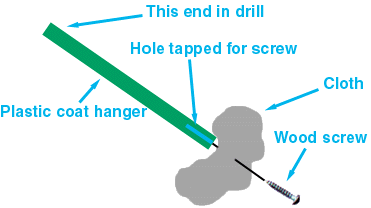
1. Take the plastic coat hanger and cut the straight part of it out.
2. In one end of the coat hanger, tap a hole for your screw with the drill bit.
3. Get just enough cloth so that it fits snugly in the barrel.
4. Screw the patch of cloth onto the top of the coat hanger.
5. Take the electrical tape, and tape over the ports in your barrel.
6. Insert the end of the coat hanger that doesn't have the cloth on it into the
drill.
7. Apply a very generous amount of the metal polish into the barrel and onto the
cloth.
8. Now crank up the drill and polish the barrel until it has a mirrory shine on
the inside.
Polishing: Others - Go Home
What it does: Reduces friction in barrel. Parts
that you can polish are the Sear (where it contacts the bolt and trigger), Trigger
(where it contacts the sear), Rear Bolt (whole thing; you can sand it smooth first),
Power Tube (where the Front Bolt contacts it; handle this piece like an egg),
Linkage Arm (whole thing), Drive Spring (outside), and Drive Spring Guide Pin
(where it contacts the spring).
Materials:
-Fine grit sandpaper (I used 1000 grit)
-Dremel/drill with polishing bit or terri cloth
-Scrap cloth
-Mothers Mag & Aluminum Polish
Note: This gets really messy.
1. Remove the pieces you wish to polish.
2. If the pieces are knicked and beaten up, sand them lightly with the 1000 grit
paper.
3. Smear the pieces with a large amount of polish and commence polishing them
with the cloth/dremel.
4. You can quit polishing when the piece is shiny like a mirror.
5. Be sure to get all residue off the pieces as this can grind away at the insides
of your gun.
Vented Elbow Mod - Go Home
What it does: Helps to alleviate blowback.
Materials:
-1/8" drill bit
-Razor knife (not really necessary)
-Ruler with millimeters
-Paper
-Scissors
-Pencil
Note: You can change the number of holes you want and how big the holes
are going to be, but you are on your own for the calculations.
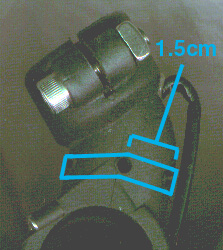
1. Make a 5mm by 9cm long strip of paper.
2. Every 1.5cm, make a line on the paper.
3. Tape the paper diagonally along the elbow as seen in the image.
4. Line the holes up how you want them, and using something sharp and pointy,
make marks where the lines are in the middle of the paper.
5. Drill holes into your marks.
6. Clean out and around the holes with a razor knife.
Putting An O-Ring On Your Stock Barrel - Go Home
What it does: Maybe it holds the stock barrel steady, I was really bored one
day...
Materials:
-Dremel with cutoff wheel or a small file.
-Tank o-ring
-Fine grit sandpaper (I used 500 grit)
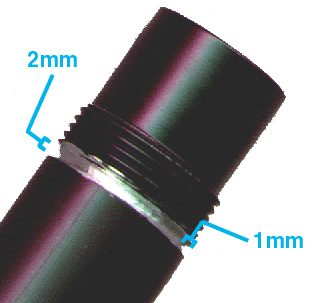
1. With the file or dremel, cut a 2mm by 1mm circle on your barrel (I ground out
a couple rounds of the threads.)
2. Take the sandpaper and round out the edges a little.
3. Make sure the groove is clean, and put the o-ring on along with a little oil.
CrowningYour Barrel - Go Home
What it does: Ever notice how you will be shooting
and a ball couple balls just seem to fly way off track? That is called a flyer.
This mod can help prevent flyers. You will get great results if you do this to
your stock barrel.
Materials:
-Ball bearing or marble (must not be able to fit inside barrel, 7/8" diameter
is what I used)
-Mothers Mag & Aluminum Polish
-500 grit sandpaper (for cheating)
Note: Do NOT try this mod if your barrel is anodized on the inside!
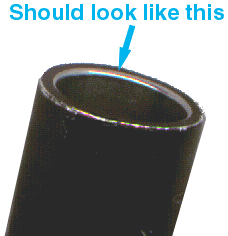
1. Take the 500 grit sandpaper and smoothen out the edges a little as seen in
the picture.
2. Spread a generous amount of Mothers Mag & Aluminum
Polish around the lip of the barrel.
3. Now comes the fun part. Rest the bearing/marble on the lip of the barrel and
start working it around in circles. Do this until you are satisfied with the size
of the lip on your barrel. It should be a smooth round bevel.
Air Assist Hopper Mod - Go Home
What it does: This mod will shoot a burst of air into your
elbow, which will help feed balls. I took my revvy off and tried rapid fire, it
worked great.
Materials:
-Velocity screw (best to use the stock delrin (plastic) one)
-Aquarium air tubing (or similar)
-Microline (or something the aquarium air tubing can slide onto)
-Drill with drill bits: 1/16" and one the size of the microline tubing.
-Glue (I used Gorialla Glue)
-Hacksaw or Dremel with cutoff wheel
-RVA (not necessary, but makes it so you wont have to use the velocity screw to
change the velocity)
-Razor knife
-Lighter
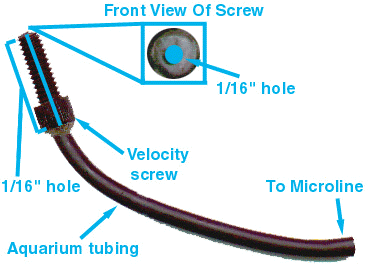
1. First off, take the 1/16" bit and drill a hole straight through the velocity
screw (see Image #1).
2. Cut about a foot of aquarium tubing, you can size it up later.
3. Glue the aquarium tubing into the head of the screw where you would normally
put the allen key. Be sure to use a generous amount of glue because this connection
will be under alot of stress. Also, be careful not to get any glue in the hole
you drilled in the screw. Let it dry for the amount of time that bottle indicates.
4. Now with the drill bit the size of the microline, drill a hole in the elbow,
just below the lip (see Image #2). Be sure to angle the hole towards the front
bolt.
5. Take the lighter, and bend the microline by heating it up. Do not overheat
the microline or it will melt together. Try to bend it so that it will resemble
Image #2. Constantly fit it to your gun.
6. Once you fit it, cut the hose flush with the the inside of the elbow using
the razor knife.
7. On Image #2, the end of the hose where the aquarium tubing connects should
be 1/2" long.
8. Now glue the microline hose into the elbow, be careful not to get any glue
inside the hose.
9. Attach the foregrip to the gun and put it in the full foward position (exposing
the front bolt), then insert the velocity screw into the gun.
10. Finally, with the foregrip still foward, fit the aquarium tubing onto the
microline hose, and cut it to length. Do this so you can expose your breach without
disconnecting the tubing.

DIY Anodizing - Go Home
What it does: This can put permanent color on aluminum.
Source from The ATM Page.
A Word of Warning
This formula uses sulfuric acid. It is dangerous stuff.
- Always wear goggles.
- Intense heat is generated when it's mixed with water
to dilute it. Always add acid to water, never pour water into concentrated
acid.
- Sulfuric acid reacts strongly with organic compounds
like cellulose (wood, cotton clothes, etc). Toxic hydrogen sulfide gas can
be released when it reacts with organic material.
- Never use a metal container. For making the dilution
Pyrex is best - regular glass could shatter, splattering hot acid everywhere,
if it heats up too much.
General
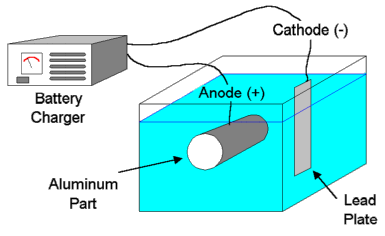
Anodizing aluminum is a two step process:
- An acid bath in which an electrical current is passed through
the part. The part to be anodized is the anode (plus terminal) and
a lead plate is the cathode (negative terminal).
-
A boiling water bath to seal the finish.
This is where dye can be added to color the part.
Preparation
- Sand the part well to remove all scratches and/or machining
marks.
- Clean the part with an abrasive cleaner (like Bon-Ami) just
before putting it into the bath.
- Avoid touching the part at this point, as oily fingerprints
may be resistant to the acid bath.
Acid Bath
- Sulfuric acid dilution should be about 15% by wieght. This
will give a specific gravity of 1.102 at 70 degrees F. The dilution is not
critical - anything from 10-20% should be fine.
- A single batch of acid can be used for several small pieces
- as much as 15 sq. ft. per gallon.
- A glass or sturdy plastic container (like a wastebasket)
can be used for the anodizing vessel - never any kind of metal.
- When the part is suspended in the bath, support the connecting
wire to make sure the part does not touch the vessel anywhere.
- Between sessions, store the acid in a tightly stoppered
glass container to prevent dilution change due to water evaporation.
Electrical
- The actual current requirements are based on the size of
the piece to be anodized. A general guideline is about 900 amps per minute
per sq. ft.
- Time in the bath is computed from the above number. For
instance, if you have 5 amps available and a 1 sq. ft. part, it needs to anodize
for 180 minutes.
- When calculating area, be sure to consider all surfaces
that will touch the acid - outside, inside, edges, etc.
- A 12V battery charger works nicely for small parts - or
even larger ones if you're not in a hurry.
- Filtering or regulation is not needed.
- A lead plate makes a good cathode as oxide build-up is minimal.
- Copper wires should not touch the acid bath! On the cathode
side, make sure the lead plate is large enough to make the electrical connection
well out of the bath. On the anode side, connect to the part with an aluminum
wire or long aluminum screw, and again, make sure the electrical connection
from the charger is well out of the bath.
- A good connection between the aluminum wire or screw and
the part to be anodized is critical. Sand both and secure them together tightly
with an aluminum nut or screw.
- The point of connection to the part will not be anodized.
So pick an out-of-the-way point to make this connection.
- Currrent flow will decrease slowly as the part is anodized,
but if falls drastically, it probably means a connection has gone bad.
Sealing and Dye Bath
- Handle the part by the connecting wire or screw at this
point - do not touch it or the surface will not dye/seal evenly.
- After the acid bath, rinse the part throughly in cold water.
- If you do not want to dye the part, just boil it in distilled
water for 30 minutes or so.
- To dye the part, first disolve the dye in the water and
let it cool. Then put the part in the cold water and bring it to a boil. If
the part is put directly into hot or boiling water, it will start to seal
before sufficient dye has been absorbed.
- Actual anodizing dyes work best, but other dyes (like Rit
clothes dye) will still give a decent color. Just don't expect a really black
black.
Other Notes
Different aluminum alloys vary in how well they anodize. General
guidelines by alloy family are as follows:
- 1000 - Good, clear
- 2000 - Poor
- 3000 - Good, Yellow-brown color
- 5000 - Excellent, bright, clear
- 6000 - Excellent
- 7000 - Fair to poor
Additional information on aluminum alloys may be found here.
Hobby shops often have a chemical anodizing agent called "Engine
Black" used for model trains. It just applies and is washed off with no acid
or electricity. The protective coating produced is not as durable as true anodizing.
Installing Anti-Siphon - Go Home
What it does: This tube sucks the gaseous CO2 from the top
of your tank. Get more shots per tank and alot more consistnecy. This anti-siphon
will be fitted to a certain gun or ASA type. If it is in upside down, it will
suck in only liquid.
Materials:
-Anti-Siphon tube (here)
-Wrenches or pliers to get valve off (a vice helps)
-Deep pan
-Water
-Red Loctite
-Wrench for Anti-Siphon tube fitting
-The ASA you want to use (leave the ASA on the gun)
Note: Make sure the tank is empty.
1. Boil the water.
2. Take the pan off the stove and hold the EMPTY tanks valve into the water for
3-4 minutes. This should loosen the Loctite.
3. Hurry and get the tools and get the valve off. This will likely take alot of
torque. A vice does wonders here. If this does not work, you can use a blowtorch
on the valve to further melt the Loctite
4. Let the valve cool down. Now get the antisiphon tube and screw it into the
back of the valve.
5. Take the valve and screw it onto the gun all the
way. Then bend the tube straight up, it should be close to touching the top of
the tank. This takes some trial and error to get it perfect.
6. Be sure to scratch a deep line into the top of the valve where the tube points
up. This way it can be used on other guns if desired.
7. Now get the Red Loctite and spread a light amount onto the lower threads on
the valve.
8. Hurry and screw the valve back into the tank. Thats it.
By: Matt
PCOG Member #149
Email: matts@antisocial.com
Copyright Matt Szabaga 2000-2001.